JOJ Ophthalmology- Juniper Publishers

Abstract
Purpose: To evaluate the change in spherical
aberration and coma in normal eyes, by employing wavefront-customized
hydrogel contact lenses.
Methods: Seven customized, computerized
numerically controlled lathe cut hydrogel contact lenses were designed
and fabricated incorporating specific amounts of spherical aberration
(SA) and coma. Each lens was designed to have only one non-zero Zernike
aberration coefficient. The lenses were fitted on three normal subjects
(total three eyes). Wavefront aberrometry was performed pre- (naked
eyes) and post- fitting.
Results: Regarding SA, modulation of the
aberration was achieved in a consistent fashion towards the same
polarity of the aberration, ranging from ~60% to +200% of the intended
change. Regarding coma, lenses that employed coma of the same sign with
the subject's coma, increased the coma of the eye-lens combination.
Lenses with opposite coma than the ocular coma decreased the on-eye
aberration coma, and even reversed it.
Conclusion: Modulation of on-eye spherical
aberration and coma in a predictable manner employing custom-designed
hydrogel lenses was achieved in normal eyes. Such lenses can be very
useful in normal eyes with subtle high-order aberrations. Wavefront
correction dispensing can be personalized, based on the design of
customized contact lenses.
Keywords:
Soft contact lens; Hydrogel contact lens; Wave front customized contact
lenses; Wavefront aberration; Zernike aberration; Keratoconus; Irregular
cornea; Keratoplasty; Irregular astigmatism; Asphericity
Introduction
The correction of high-order aberrations is a
long-sought target in vision research. Through studies of ocular
aberrations have demonstrated that most eyes exhibit low to moderate
amounts of high order aberrations (HOA) [1-6].
Normal, healthy eyes, such high-order aberrations associated with the
anterior cornea are partially-compensated by the aberrations (due to
their opposite sign) of the intraocular optics such as the crystalline
lens [7].
Hydrogel (soft) contact lenses (CL) are typically
used in normal eyes, but their effect in restoring significant, non-
rotationally symmetric aberrations is limited. Hydrogel CLs for such
irregular corneas exist, but they do not achieve satisfactory
corrected-distance visual acuity (CDVA) results in such eyes [8].
Another drawback of the existing CLs is that in order to mask
aberrations, conventional CLs employ an increased lens thickness which
results in a reduced oxygen permeability [9].
In the quest for improved vision restoration and
comfort in normal eyes with some amounts of HOA, we propose soft CLs
that employ custom HOA correction. These lenses should be of regular
thickness; the correction can be implemented in the front lens surface,
while the back surface is designed to aim for the clinically optimal
fit. Alternatively, the correction can be implemented on the back lens
surface, which theoretically will lead to a better fitting, especially
in slightly distorted corneas. As many aberrations are not
rotationally-symmetrical, the optical zone of such a lens should have a
non-uniform thickness in order to achieve the desired correction,
dependent on the amount of aberrations to be corrected and on the
optical zone.
Our team has previously demonstrated [10]
that wave front-customized soft contact lenses implementing correction
of vertical coma improve visual performance in eyes affected with mild
or moderate keratoconus. Optical quality and visual performance with
such customized soft contact lenses for keratoconus eyes has been also
proven efficient by other investigators [11,12].
The purpose of this study is to measure the effect of hydrogel CLs
incorporating SA and coma in normal, healthy eyes in modulating such
ocular aberrations. We seek, in other words, to demonstrate the
feasibility of modulating HOAs in a controlled fashion. This will have a
significant impact in wave front customized hydrogel CL design, as
modulation of CL asphericity may be among the key factors in order to
achieve management of presbyopia correction with contact lenses [13].
To this purpose, we designed and manufactured two
types of customized contact lenses, and studied their on-eye
performance. The first type implemented an anterior surface design with
(fourth-order Zernike) spherical aberration (SA), the second type
implemented (third-order Zernike) coma design. The reason we chose
fourth-order SA and third-order coma as targets is that these
aberrations are the main degraders of retinal image quality and visual
performance, amongst all HOAs [14-16].
Methods
Design and fabrication
A computerized numerically controlled (CNC) lathe
(Optheq, Contamac, UK) and the accompanying software (Calculens v.2.7,
Contamac, UK) were employed to implement the custom design and
fabrication. All lenses incorporated the designed HOA correction on the
anterior surface. Each lens was designed to have only one non-zero
Zernike aberration coefficient. Notation of SA and coma is according to
the ANSI standards [17]. The lenses were designed and fabricated to have a certain type and amount of HO aberration over a 3.5mm pupil diameter.
The first type of lenses included a lens with positive 4th
order SA (referred to as Sph+0.200), and three lenses with negative SA
(referred to as Sph-0.030, Sph-0.100, and Sph- 0.150, respectively). The
above numbers indicate the amount of spherical aberration (in |im
root-mean-square RMS) implemented in the design. The second type of
lenses employed 3rd order coma aberration as follows: the first lens
(referred to as X-0.100) employed negative horizontal coma, and thus the
orientation of coma was perpendicular to the lens stabilization
modality (in these lenses, a prism ballast). The second lens employed
negative vertical coma (referred to as Y-0.070) and the third lens
(referred to as Y+0.150) employed positive vertical coma. The numbers
again indicate the amount of coma in |im RMS implemented in the design.
All of the lenses (total: 7) were of 8.4mm base curve, 14.5mm total
diameter, 3.5mm optical zone diameter for the sphero cylindrical
correction. The material was GM3 49% (Contamac, UK), which has 49% water
content and a Dk value of 15.9. Central lens thickness was 0.12mm.
After lathing, the lenses were properly hydrated. The design parameters
were verified with a Clear wave Contact Lens Precision Aberrometer
(Wavefront Sciences-now Abbott Medical Optics, USA), and a Rotlex
Contest Plus lens analyzer (Rotlex, Israel). The Rotlex analyzer
operates on the principle of Moire deflectometry [18], and outputs data in diopter format.
Lens fitting and measurements
Prior to the measurements with the wave front-guided
lenses, informed consent was obtained from all three volunteer subjects.
The lenses were fitted on the right eye of each subject. Each subject
wore every custom lens. Prior to measurements, the fit of the lenses was
checked in a slit lamp, to ensure that it fell within acceptable
clinical standards [19].
Moreover, regarding the lenses employing coma, which employed a
prism-ballasted stabilization method, it was also verified that lens
orientation did not exceed 5 degrees. Lighting in the examination room
was controlled, in order to avoid excessive dilation of the subject's
pupil, beyond the 3.5mm optical zone of the lenses. No other measurement
or estimation of lens misalignment, either rotation or translation, was
performed on this stage.
Three consecutive measurements were taken and
averaged with each of these lenses, with the COAS Wave front analyzer
(Complete Ophthalmic Analysis System, Wave front Sciences, now Abbott
medical Optics- USA). The COAS uses the Scheiner- Hartmann-Shack
principle [20],
which is embodied in a variety of clinical instruments, and its
effectively in clinical use is documented by the peer-reviewed
literature [21].
We performed the above measurements in order to ensure that any change
in SA or coma of the wave front lens-eye combination was due to the
customized lenses. As baseline reference measurements (also three
consecutive) we used those of the naked eyes to be tested, without any
lenses worn. After data collection, the Zernike aberration coefficients
were computed for a 3.5mm pupil size employing the COAS' software.
Results
The spherical aberration of the eye of subject 1 was
positive (0.012|im RMS), and moved to even more positive values with the
Sph0.200 lens worn. When the lenses employing negative spherical
aberration were worn, spherical aberration moved to more negative
values. Similar results were observed for subjects 2 and 3. The
spherical aberration of the right eye of subject 2 was 0.023|im RMS and
moved to more positive values when the plano lens and the Rx lens were
worn. The results for all lenses are presented in (Table 1-3).
With the Sph+0.200 lens that introduced positive spherical aberration,
the on-eye result in all patients became even more positive, whereas it
became progressively more negative with the lenses implementing negative
spherical aberration. It is, therefore, obvious that the lenses fit on
all subjects, had the desired effect of changing the spherical
aberration to the desired direction, and the change
was quite proportional to the spherical aberration of the lens.
considerably between subjects, as the Sph+0.200 lens induced However,
there was considerable inter-subject variability 51%, 83%, and 42%
spherical aberration than intended to of the effect, as reported in (Tables 1-3). This change varied subjects 1,2 and 3, respectively.

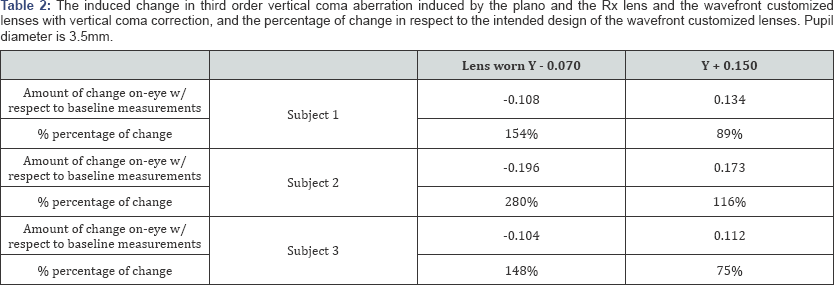
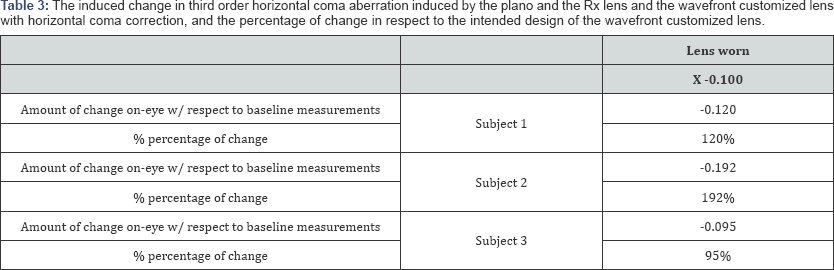
The results presented in Table 3 for the
coma-implementing lenses bear similarity to those from the spherical
aberration- implementing. The lens whose off eye aberrations was closer
to the intended design, the Y -0.070 lens, had also variable effect in
the three subjects' eyes, as it induced ~150% more negative coma than
intended in subjects 1 & 3, and induced a 280% more coma in subject
#2.
Discussion
The design and fabrication of wave front-customized
lenses in both healthy and abnormal eyes has been demonstrated by
Lopez-Gil et al. [22],
where three groups, namely normal, keratoconic and post-keratoplasty,
were evaluated for the effects of customized lenses on total and
high-order aberrations. They found that wavefront-customized lenses
reduced total aberrations on all three categories, but reduced HOA only
in the keratoconic group. They attributed this to better stability of
the customized lenses on the keratoconic corneas, whereas increased
translation and rotation on the normal and postkeratoplasty corneas
caused an increase of HOA. Regarding irregular eyes, Marsack et al. [23]
designed, fabricated, and fitted a customized, lathe-cut contact lens
in one eye of a keratoconus patient. This lens was found to
significantly reduce HOA in the keratoconic eye, and consequently,
improve vision. Sabesan et al. [24],
followed the same procedure on a population of keratoconic eyes, and
additionally compensated for decentration and rotation. They found that
their customized lenses improved vision compared to a conventional soft
lens and an RGP lens. Chen et al. [25],
also fitted a group of keratoconic eyes with posterior-surface
customized hydrogel contact lenses. These lenses were produced by
sculpting the back surface with an excimer laser, in order to improve
conformance of the lens to the cornea. These lenses created an
overcorrection of ocular aberrations, due to the aberrations of the
internal optics of the eye being revealed. To the best of our knowledge,
there has not been so far a study of different types of
wavefront-customized hydrogel contact lenses, targeted to one HOA mode
each, and with various aberration magnitudes, in order to observe and
measure the results on normal, healthy eyes. Such lenses, combined with
the appropriate sphero cylindrical power, can be used to correct subtle
HOA in normal healthy eyes and maximize visual performance, and in
certain cases might even result in vision better than 20/20 [26,27].
Other cases that can benefit from wavefront-customized lenses with
subtle HOA, are ones with small amounts of coma, such as sub-clinical
keratoconus or mild irregular astigmatism.
The mathematical process of designing a wavefront correction in a hydrogel CL has been reported by Almeida et al. [28].
If correction of spherical aberration (SA) is desired, such as in the
majority of normal eyes, or in cases of post-refractive surgery with
small ablation zones or in central keratoconus, there should be a large
radial symmetrical variation in lens power, from the lens center to the
periphery up to the edge of the optical zone. This was the path followed
by Dietze et al. [29,30],
who designed and fitted on myopes and hyperopes a series of
SA-correcting hydrogel CLs with spherical power, based on aberrometry
data. They found that these lenses reduced SA, but increased total HO
aberrations and did not improve vision compared to spectacles, regular
spherical hydrogel CLs, or CLs designed to be aberration-free in air.
They attributed this to the amount of uncorrected astigmatism, which in
their study had a mean value of -0.50dpt, as the blur that it could
cause on image quality surpassed the benefit of correcting SA, and to
the small effect that such minor amounts of SA found in normal eyes.
They concluded that normal subjects might benefit from such lenses in
low-light conditions, where natural pupil dilation occurs and the
corresponding SA is increased.
If coma reduction is the desired target, as in
paracentral keratoconus, inside the optical zone of the lens there
should be a coma-like pattern of refractive power, with the portion with
the reduced refractive power located opposite to the cone, and the
portion with the increased refractive power located against the rest of
the cornea, covering the pupil. The latter modality obviously needs lens
stabilization methods, in order to achieve proper orientation on the
cornea and avoid lens rotation. The design of such lenses for HOA
demands sophisticated lens design, and in the manufacturing process, a
CNC lathe or an ablating laser should be used. Also, advanced optical
quality setup is needed to measure the shape and verify the
functionality of such lenses, as the simple (universally used) focimeter
and the radiuscope are not sufficient enough. This study demonstrates
the concept that wavefront-customized hydrogel contact lenses can be
used for the manipulation and correction of ocular coma and spherical
aberration in normal eyes. The results show that hydrogel lenses can
modulate the Zernike aberration coefficients of the lens-eye
combination, and specifically, coma and spherical aberration. The
modulation can be predictable, to an extent beyond that possible with
standard hydrogel contact lenses. It can be concluded that such lenses
can be utilized in a clinical practice for providing custom wavefront
vision correction. As the main reason of retinal image degradation,
beyond sphero cylindrical errors, are SA and coma, we targeted these
particular aberrations for designing and fitting wavefront customized
hydrogel contact lenses.
It is well-known that once fitted properly, a
hydrogel contact lens conforms to the corneal surface, in a manner which
depends on the corneal topography, the geometry and the design of the
lens, the material of the lens and the interaction with the tears. In a
study by Jiang et al. [31],
it was found that different types of hydrogel CLs alter the wavefront
profile of the eye in a manner that differed considerably from one lens
type to another. They hypothesized that this can be attributed to the
optical quality and the design of the lenses, the lens centration, the
tear film quality and the level of deformation of the lenses on the
cornea. Also, Lu et al. [32],
found in their study that hydrogel CLs had a trend towards inducing
HOAs when worn. However, more research is warranted in order to
investigate the alteration in the shape of wavefront-customized contact
lens surfaces, anterior or posterior, when worn on the eye, as they
might not have a uniform thickness, and deformation will affect visual
performance.
Our results support the above hypothesis. The
wavefront- customized lenses had different effects on the subjects'
eyes, regarding the change of the magnitude of the targeted aberrations.
This can be attributed to variable levels of lens deformation on the
corneas of the subjects, which itself depends on corneal topography,
lens design, tear film quality (which, along with micro-differences in
the fit between the two subjects, might lead to variable patterns of
lens dehydration), and lens translation and rotation.
The other major factors that affect the on-eye
results of such lenses are rotation and decentration. We did not include
calculations of coefficient transformation based on lens rotation and
translation, as we wanted to test the hypothesis that wavefront
dispensing can be performed without the tedious measurements and
mathematical procedure associated with the above. However, we ensured
that the fitting was at least clinically acceptable, which means that
the lens was well-centered, and did not rotate more than 5 degrees or
decentered more than 1-mm on blink. De Brabander et al. [19],
have demonstrated through simulations that these criteria are more that
acceptable for obtaining a benefit from a wavefront correction. Based
on the results of our study, we believe that this hypothesis is valid,
but the dispensing procedure might need to be further personalized and
customized.
Cox et al. [33], have already described and patented [34],
a process of wavefront dispensing. They stated that dispensing should
begin with the fitting of a trial lens with macro parameters (thickness,
base curve, diameter, sphero cylindrical power) as close as possible to
the final wavefront lens. The correct clinical fit should be verified,
and then the rotation and decentration of the lens should be recorded,
and new wavefront measurements should be taken with the lens in situ.
Lastly, the wavefront customized lens is designed based on the on-eye
aberration pattern and the lens rotation and translation.
We believe that this procedure can be simplified by omitting the measurements of lens position and rotation. Guirao et al. [35],
report a computational method for estimating the correction by taking
into account translation and rotation. However, in another study which
utilized an adaptive optics (AO) system [36],
it is reported that the lens rotation and decentration normally found
in practice (and which are clinically acceptable) still produce better
visual results compared to conventional, non-wavefront customized
contact lenses. The same results were found in another theoretical study
by the same authors, which employed computations of the performance of
an ideal wavefront CL after decentrations and rotations [37]. Based on our work and the studies described above [35-37]
the authors believe that wavefront CL dispensing can be performed in
the standard clinical practice, employing the current clinical standards
of a good clinical fit, omitting the steps of measuring the lens
position and rotation and recalculation of the coefficients. However, if
the desired result is not achieved, due to lens rotation, decentration,
deformation or all of the above, the new step that has to be added is
the calculation and order of a new wavefront customized hydrogel CL.
The amount of aberration implemented on the new lens
should depend on the amount of the first wavefront lens and the amount
of change that it induced to the targeted aberration or aberrations.
Alternatively, in order to avoid excessive reordering, the practitioner
may have at his disposal a series of trial wavefront customized hydrogel
CLs, with predetermined amounts of certain aberrations in multiple
magnitudes. He should then choose the first lens based on the
aberrometer results, fit the lens, re-measure the on-eye aberrations and
over-refract, and order the final lens with increased confidence. Even
then, the expected result might not be fully achieved, mainly due to
different patterns of deformation of the two slightly different lens
geometries on the cornea. This difficulty might be larger in normal eyes
which nevertheless have minor amounts of HOA, due to the instability of
HOA over time [6], and to fluctuations caused by accommodation [38].
Various studies have already demonstrated, both
theoretically and in a clinical setting, the feasibility of a custom
wavefront hydrogel CL correction in abnormal eyes, and also investigated
the required extent (in Zernike orders) of such a correction. As
mentioned above, such eyes present with large amounts of HOAs, mainly
coma and spherical aberration. In addition to abnormal cases, patients
who present with mild amounts of coma, trefoil, and related high order
aberrations can also benefit from this technology. Cases with small
amounts of coma include sub clinical (form fruste) keratoconus, and
mildly asymmetrical corneas. Maximizing visual performance in such eyes
requires correction for the majority of the above aberrations. In
specific, spherical aberration management wavefront lenses can be of
great value both in normal eyes, with small to moderate amounts of
spherical aberration, and also to cases such as central keratoconus or
post-refractive surgery corneas, with small ablation zones over a large
pupil. Correction of spherical aberration in the former is supposed to
maximize visual acuity and hypothetically lead to supernormal visual
performance, although previous studies did not succeed to increase
acuity with the use of such lenses. In the latter is expected to restore
vision, especially in medium and low contrast environments and in
mesopic or scotopic levels of lighting [39] where large amounts of spherical aberration lead to the subjective impression of halos and blur circles.
Trefoil, tetrafoil, and related aberrations that are
positioned near the edges of the Zernike pyramid are considered to have
less impact in vision that aberrations near the center of the Zernike
pyramid, if the same amount of RMS error is considered [23].
However, patients who have undergone penetrating keratoplasty often
present with a substantial amount of such aberrations due to variable
suture tension [40], and the study of Marsack et al. [41],
implied that these aberrations should also be corrected in keratoconus
eyes. The perceptual ability of each individual should be taken into
account when designing a wavefront correction. When a person reads a
visual acuity chart, he translates the PSF at the retina (formed by the
eye's optics) into familiar words or numbers. This PSF is unique to each
individual, and its basic shape remains basically unchanged through
age. There are two possibilities when correcting most of the eye's high
order aberrations. The first is to reduce the total RMS error (as
measured by an aberrometer) and increase the Strehl ratio, but at the
same alter the shape and/or direction of the PSF on the subject's
retina. For example, one could slightly overcorrect a large amount of
coma and change its sign from positive to negative or vice versa, and at
the same time, the total RMS error could be less than the previous
uncorrected state and the Strehl ratio increased. The second possibility
is to reduce the RMS error and not alter the shape of the PSF. In the
above example, this can be achieved by carefully avoiding overcorrection
of coma. If this can be achieved, the total RMS error is reduced, the
Strehl ratio increased, and the shape and the direction of the PSF
remain basically the same.
If by employing a wavefront correction the first
scenario is realized, it is possible that the person will lose
corrected- vision lines, despite seeing through better optics, as he is
not accustomed to translating the new image shape in his retina. In a
study by Artal et al. [42],
it was discovered with the help of AO, that subjects had a sharper
impression of a certain stimulus when they viewed it with their own
aberrations, than with a rotated version of their aberration pattern. In
a consequent study, Chen et al. [43],
found that the best subjective image quality did not coincide with the
best possible retinal image quality, and neural adaptation occurred,
although the 'intensity' or duration of this phenomenon was not
investigated. Other studies [44,45]
have found that perceptual adaptation to myopic blur occurs to both
myopic and emmetropic subjects, and both grating and letter acuity
improved after a period of exposure to myopic defocus. Thus there is a
risk of reducing visual acuity associated when dispensing wavefront
guided contact lenses, although if the wavefront guided correction
provides better vision at the time of the initial fit, this risk is
considered minimized.
Conclusion
This study demonstrates that wavefront-customized
hydrogel contact lenses can be used for the modulation and correction of
spherical aberration and coma and in normal eyes. The results show that
wavefront-customized hydrogel CLs can change the Zernike aberration
pattern of the lens-eye combination, and specifically, spherical
aberration and coma, in a predictable fashion. Such lenses may be
utilized in a clinical practice for providing custom wavefront vision
correction in both normal and abnormal eyes, by following the current
clinical standards of a good fit. However, as the effect of a customized
CL with a predetermined amount of aberrations differs from eye to eye,
in the presence of residual aberrations new lenses can be designed,
based on the change in aberrations imposed by the first ones. Larger
studies need to be undertaken, in order to test the large-scale
feasibility of such a procedure, as there is a considerable contribution
of the neural factor in visual performance. If, however, such a method
can be found to be reliable, it would greatly simplify wavefront
dispensing for the everyday clinical practice.
For
more Open Access Journals in Juniper Publishers please
click on: https://juniperpublishers.com/index.php
For more articles in JOJ Ophthalmology (JOJO) please click on: https://juniperpublishers.com/jojo/index.php
